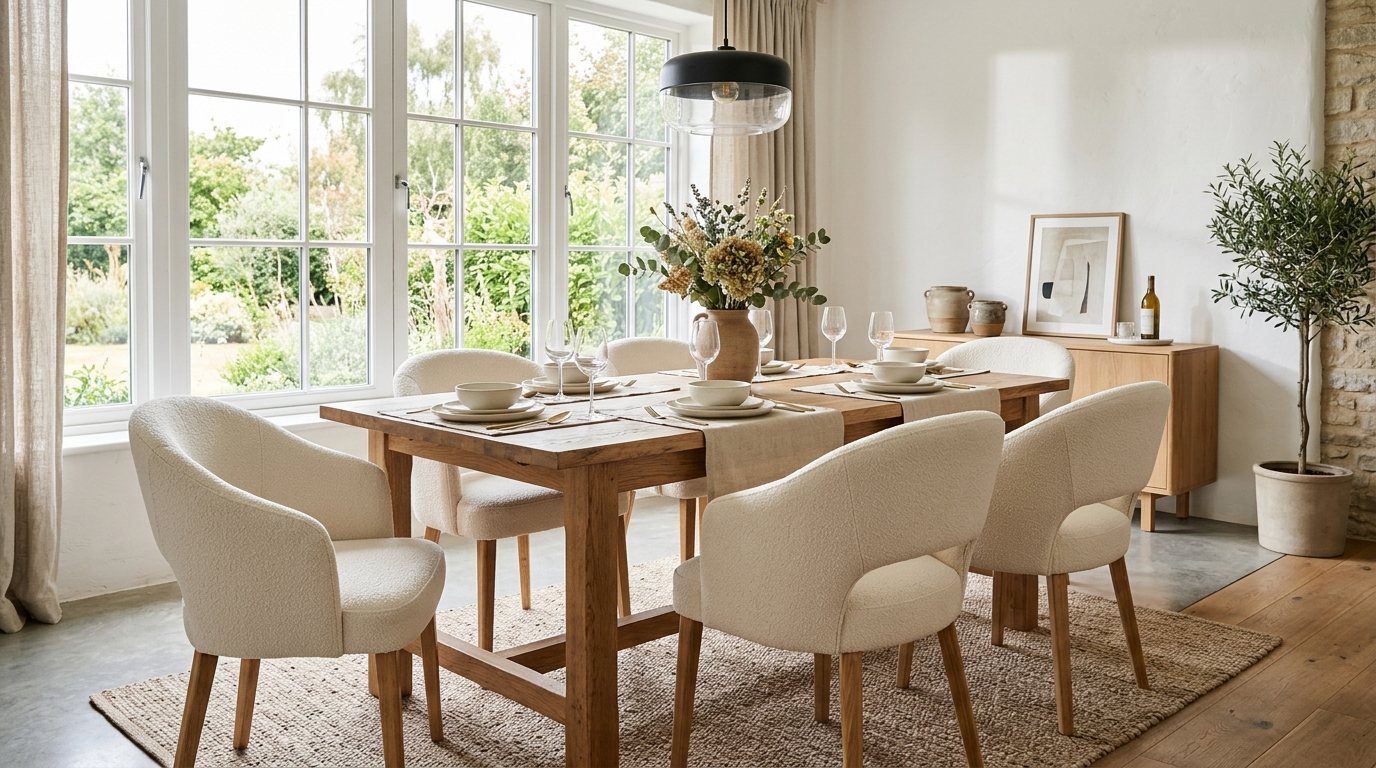
The right dining chairs make a long meal feel relaxed, and the wrong ones leave everyone shifting in their seats. This guide explains how to choose dining chairs: the seat height that works with your table, the width each person needs, the trade-offs between upholstered and wood, and how to mix styles with confidence. Browse our dining chairs once you have measured your table.
Match Seat Height to Table Height
A standard dining table stands about 28 to 30 inches (71 to 76 cm) high. Dining chair seats usually sit 17 to 19 inches (43 to 48 cm) off the floor, which leaves roughly 10 to 12 inches (25 to 30 cm) between the top of the seat and the tabletop. That gap gives your legs room without making you reach up to your plate.
Check the underside of the table too. Measure from the floor to the bottom of the apron, the frame that runs below the top. If you plan to push armchairs under the table, the arms must be lower than the apron. Counter-height tables of about 36 inches (91 cm) need taller stools, not dining chairs.
Width, Spacing and How Many Chairs Fit
Allow about 24 inches (61 cm) of table edge for each person, and 26 to 30 inches (66 to 76 cm) if you choose armchairs. Side chairs are often 17 to 22 inches (43 to 56 cm) wide, and armchairs 22 to 26 inches (56 to 66 cm). A 72-inch (183 cm) table seats three people on each long side, and extra chairs at the ends bring it to eight.
- Behind the chairs: leave at least 36 inches (91 cm) from the table edge to the wall so people can pull out.
- Walkways: allow 44 to 48 inches (112 to 122 cm) if people need to walk behind seated diners.
- Seat depth: 16 to 20 inches (41 to 51 cm) suits most adults.
The shape of the table changes how many people sit comfortably, which our article on round vs rectangular dining tables explains.
Upholstered or Wood Chairs?
- Upholstered: padded seats, and sometimes backs, are kinder during a long dinner. For a busy household, look for tightly woven or performance fabrics, darker or patterned colours, and wipe-clean materials such as leather. Check the care label for cleaning instructions.
- Wood: hard-wearing, easy to wipe and a classic match for most tables. A seat pad adds comfort when you want it.
- A mix: a wood frame with an upholstered seat keeps most of the cleanability and adds comfort where you sit.
If your table is wood as well, our guide to cleaning and protecting a wood dining table covers coasters, placemats and everyday care.
Arms, Backs and Comfort Details
Armchairs add support and a more formal look, but they take up more room and need clear space under the apron. Side chairs slide in easily and are the better fit for smaller rooms. A low back, around 34 to 36 inches (86 to 91 cm) in overall height, keeps the room open, while a taller back adds presence.
Sit in the chair for at least five to ten minutes if you can. Your feet should rest flat on the floor, the seat edge should not press behind your knees, and the back should support you without pushing you forward. Rock the chair gently as well. Joints should feel solid with no creaking, and felt pads on the feet protect hard floors.
Mixing Styles, Host Chairs and Benches
You do not need every chair to match. Keep one element consistent, such as the colour, the leg shape or the wood tone, and vary the rest. Seat heights should stay within an inch (2.5 cm) of each other.
- Host chairs: place two armchairs at the ends and side chairs along the sides, or use a different fabric or colour at the ends.
- Mixed chairs: use two or three styles in the same colour family, rather than several unrelated designs.
- Benches: a bench along one side seats two or three people and tucks fully under the table, which saves space and suits children. It has no back, so it works best for casual or shorter meals.
Our dining benches are a practical way to add seats without crowding the table.
A Simple Checklist Before You Buy
- Measure the table height and the clear height under the apron.
- Decide how many people you seat on a normal night and how many on a busy one.
- Work out chair width with the 24 inch rule, and leave a few inches spare.
- Choose upholstered, wood or a mix based on how your household eats.
- Sit for several minutes, then check stability, finish and the fabric's care label.
Spending a few minutes on these steps usually matters more than any single style choice, because comfort and fit are what you notice at every meal.
Frequently Asked Questions
How much space should there be between the chair seat and the table?
Aim for roughly 10 to 12 inches between the top of the seat and the tabletop. For a table about 30 inches high, that means a seat around 18 inches. Also make sure the chair arms, if any, sit below the table apron so the chair slides in.
How many chairs fit at my dining table?
Allow about 24 inches of table edge per person, or 26 to 30 inches if the chairs have arms. Divide the long side of the table by that number, then add one chair at each end if there is space. Leave 36 inches behind each chair to pull out.
Are upholstered dining chairs practical for families?
They can be. Choose a tightly woven or performance fabric in a forgiving colour, and read the care label. Wipe-clean materials such as leather work well too. If you worry about spills, pick wood chairs with upholstered seats only, or look for seat covers that the maker says can be cleaned.
Can I mix a bench with dining chairs?
Yes. Put the bench along one side and chairs on the other, with armchairs or host chairs at the ends. Match the bench seat height to the chairs within an inch, and use a similar wood tone or fabric colour to tie them together.
Sit Down and Compare in Person
Dining chairs are best judged by sitting in them for a few minutes. Visit our showroom at Unit D200, 9737 Macleod Trail SW in Calgary, bring your table measurements and compare heights and fabrics, or browse our dining tables online to find a match for the chairs you like.

Comments
Loading comments...
Leave a comment
Your email address is never shown or shared. Comments are read by our team before they appear.