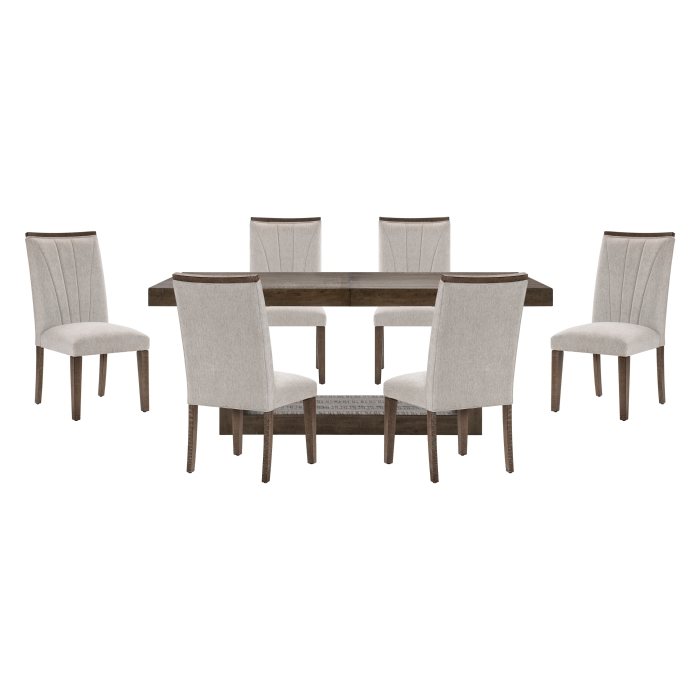
Solid wood vs MDF furniture is one of the most common questions shoppers ask, and the tag on a dining table or dresser rarely explains it. This guide covers what solid wood, plywood, MDF and particleboard actually are, where each one is used, and how to read a product description. It will help you compare dining sets and other wood pieces with confidence.
Solid Wood: What the Term Means
Solid wood is lumber cut from a tree and used as boards. Oak, maple, walnut, birch, pine and acacia are all common. A table top made from solid boards shows real grain that runs through the thickness of the board, and a small scratch can often be sanded and refinished.
Solid wood also moves. Boards swell a little in humid weather and shrink in dry air, which is something to remember in Alberta, where heated homes get very dry in winter. Good makers allow for that movement in the way tops are joined. Small seasonal changes or hairline gaps at joints can be normal in a solid wood piece.
Be careful with wording. "Solid wood construction" on a listing may describe only the frame or the legs, while the top and drawer fronts use something else. If the details matter to you, ask which parts are solid wood.
Plywood: Layers Glued Together
Plywood is made from thin sheets of wood veneer glued in layers, with the grain of each layer turned at right angles to the next. That cross-grain layering makes a sheet stable and resistant to splitting along the grain.
Furniture makers use plywood for sofa and chair frames, drawer bottoms, cabinet backs and bed slats. A well-made plywood part is often a sensible engineering choice, not a shortcut. Quality depends on the number of layers, the glue and how the parts are joined, so judge a piece on its overall build rather than on the word plywood.
MDF and Particleboard: Engineered Wood
MDF stands for medium-density fibreboard. It is made from fine wood fibres pressed with resin into a smooth, uniform panel. Particleboard is made from larger wood chips or particles pressed with resin. Both are called composite wood or engineered wood.
These materials are smooth and consistent, and they hold paint and veneer well. That makes them common for dresser carcasses, shelving, desk tops and the flat panels on cabinets. The trade-offs are general ones:
- They tend to be heavier than a similar piece in solid wood.
- Edges and screw holes can be less forgiving, so repeated assembly and disassembly can loosen fixings.
- Standing moisture is a problem, so wipe spills quickly and keep them away from damp spots.
- Surfaces covered in laminate or veneer are hard to refinish if the surface layer is damaged.
None of this makes engineered wood a poor choice. Plenty of well-built furniture uses it where a flat, stable panel is the right tool. What matters is that the piece is described honestly.
Veneer and Laminate: The Surface Layer
Many pieces combine materials. Veneer is a thin slice of real wood glued over a core such as plywood, MDF or particleboard. It gives the look of solid wood grain with more stability across a wide panel. Laminate is a printed or coloured surface layer, often chosen for durability and consistent colour.
A listing that says "wood veneer" or "wood and engineered wood" is telling you the truth about a mixed build, and that is a good sign. Descriptions that only say "wood" without detail leave you to ask questions. If you are weighing how different materials age, our article on how long furniture should last is a useful companion.
Why Composite Wood Rules Exist in Canada
Composite wood panels are bonded with resins, and some of those resins can release formaldehyde. Canada regulates this through the Formaldehyde Emissions from Composite Wood Products Regulations, made under the Canadian Environmental Protection Act, 1999. They set emission limits for hardwood plywood, particleboard, MDF and thin MDF panels, and for products made from them, that are imported, sold or offered for sale in Canada. You can read the full text on the Justice Laws website, and the official Canada Gazette publication includes a plain-language summary of what the rules are meant to achieve.
The practical point for a shopper is simple: engineered wood in Canada is covered by rules, so it is reasonable to ask a retailer about a product's composite wood compliance. Details differ by product and can change, so rely on the official pages for the current requirements.
How to Check a Piece in the Showroom
You do not need tools to learn a lot. Use this short checklist when you look at a table, dresser or bed:
- Read the product tag and description for the words solid, veneer, laminate, plywood, MDF or particleboard, and ask which parts use which material.
- Look at the edges of a table top and the sides of a drawer. Visible layers, a visible grain match or a clean veneer line tell you a lot.
- Open and close drawers. They should slide smoothly and sit square, and the drawer box should feel solid.
- Gently push on the piece. A well-joined frame stays steady and does not creak or rack.
- Lift a corner or an end if you can. Weight alone does not prove quality, but extreme lightness or heaviness is worth asking about.
- Ask for the care instructions and warranty information for that specific piece.
For wood tables in particular, our guide to cleaning and protecting a wood dining table explains daily care that suits most finishes. Always follow the maker's care label.
Frequently Asked Questions
Is solid wood furniture always better than MDF?
No. Solid wood has real grain and can often be refinished, but it moves with humidity and can cost more to build. MDF is stable and smooth, which suits flat panels. A well-made piece in either material can serve you well. Judge the joinery, finish and care guidance, not just the material name.
How can I tell if furniture is solid wood or veneer?
Check the tag first, then look at the edges and underside. Real veneer shows a thin line at the edge, while solid boards show grain that continues around the corner. Grain that repeats exactly across a panel can point to a printed laminate. If you are unsure, ask for the construction details in writing.
Does plywood mean low quality furniture?
Not by itself. Plywood is widely used for frames, bed slats and drawer bottoms because layered sheets are stable and strong. Quality depends on the grade, the glue, the number of layers and how the parts are joined. Look at the whole build and read the warranty information for that piece.
Are there Canadian rules for MDF and particleboard furniture?
Yes. Federal regulations made under the Canadian Environmental Protection Act, 1999 set formaldehyde emission limits for composite wood panels such as particleboard and MDF, and for products made from them, sold in Canada. Details and coverage can change, so check the current text on the Justice Laws website, and ask the retailer about compliance for a specific piece.
See the Materials in Person
Photos only go so far with wood. At our Calgary showroom at Unit D200, 9737 Macleod Trail SW, you can run a hand along the edges, open the drawers and compare finishes side by side. Browse our dressers and bedroom sets online first, then ask a team member to point out how each piece is built.






Comments
Loading comments...
Leave a comment
Your email address is never shown or shared. Comments are read by our team before they appear.